
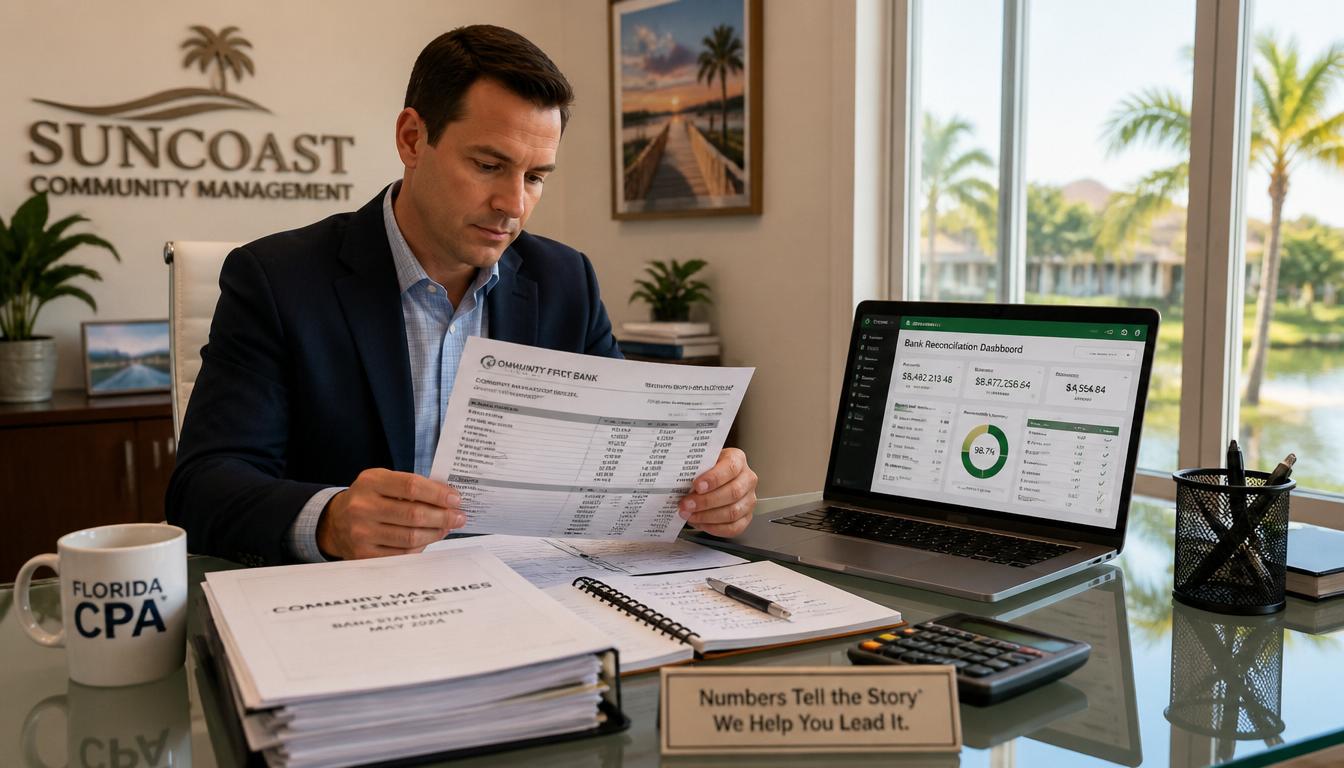

What Is Bank Reconciliation for HOAs?
Florida community associations move money through bank accounts every single day, and confirming those records match matters enormously. Bank reconciliation for hoas is the process that verifies association financial records align exactly with what the bank reports.
Chapter 720 of the Florida Statutes requires associations to maintain accurate financial records at all times. Reconciliation sits at the foundation of that accuracy. Therefore, a consistent reconciliation process protects the association from costly errors and undetected discrepancies.
Defining Bank Reconciliation for HOAs
The process compares every transaction recorded in the association’s books against every transaction reported by the bank. Each deposit, withdrawal, and fee must match between both records. Furthermore, any difference between the two must be identified and explained before the books can be considered accurate.
Outstanding checks and deposits in transit often account for temporary differences within bank reconciliation for hoas. Boards that understand these normal timing gaps avoid unnecessary alarm over discrepancies that resolve naturally. Consequently, a properly trained reviewer distinguishes between timing differences and genuine errors.
Core Steps in an Effective Reconciliation Process
Multiple steps must occur in sequence for reliable results. First, the reviewer compares the bank statement ending balance against the book balance for the same period. Second, every outstanding check and deposit in transit gets identified and added back into the calculation. Moreover, any bank fees or interest earned must be recorded in the books if they were not already captured.
Discrepancies require investigation immediately once identified. The reviewer traces each unmatched transaction back to its source document to determine the cause. This step prevents small errors from compounding into larger problems over time.
Statutory Requirements Affecting Reconciliation Practices
Statutory obligations rarely specify the exact reconciliation method an association must use. However, Florida law does require associations to maintain financial records that accurately reflect the association’s true financial position. Therefore, boards must implement a reconciliation process that satisfies both operational accuracy and statutory accountability.
Associations operating under Florida Statute 718 or 720 must produce reconciled financial records during financial reviews and audits. Incomplete or inconsistent reconciliation creates significant complications during these statutory reviews. Boards that reconcile monthly avoid unnecessary scrutiny and delay.
Why Manual Reconciliation Creates Unnecessary Risk
Manual reconciliation creates unnecessary risk for community associations of every size. Spreadsheets require constant manual entry, and human error compounds quickly across multiple bank accounts. Purpose-built software designed for bank reconciliation for hoas reduces these risks substantially.
Automated systems import bank transactions directly into the accounting platform. Matching algorithms identify corresponding entries automatically, which saves significant staff time. Furthermore, exception reports flag any transaction that requires manual review.
How Technology Strengthens Reconciliation Accuracy
Once transactions move through an automated reconciliation system, a documented audit trail forms for every bank account the association maintains. This documentation proves invaluable during financial audits, board transitions, and disputes over account balances.
Organized reconciliation records, in turn, support accurate financial statement preparation. Balance sheets depend entirely on knowing the true cash position of the association. Therefore, consistent reconciliation directly improves the reliability of every financial report produced.
Connecting Reconciliation to Fraud Prevention
Reconciliation does not exist purely for accuracy. The process also serves as a critical fraud prevention control within the association. Additionally, unauthorized transactions become visible almost immediately when reconciliation occurs on a regular schedule.
Boards that reconcile monthly catch unauthorized withdrawals quickly. They can act before significant losses accumulate. Moreover, frequent reconciliation discourages internal fraud, since anyone with access to the accounts knows the records receive close scrutiny.
Preparing Records for CPA Review and Audits
CPAs reviewing association finances rely heavily on clean, consistent reconciliation records. Disorganized reconciliation slows down annual reviews and increases the professional fees associations pay for audit services. Consequently, associations that maintain consistent bank reconciliation for hoas reduce both audit time and audit cost.
Property managers who oversee multiple associations benefit significantly from standardized reconciliation processes. A unified approach to reconciliation strengthens trust between boards, managers, and the CPAs who review the books.
Steps for Achieving Goal
- Establish a written reconciliation policy that defines the frequency, responsible party, and review process for every bank account.
- Compare the bank statement ending balance against the book balance for the same reporting period every month.
- Identify every outstanding check and deposit in transit, then incorporate those items into the reconciliation calculation.
- Record any bank fees, interest earned, or other adjustments in the books immediately upon discovery.
- Investigate every unmatched transaction back to its original source document before closing the reconciliation period.
- Adopt purpose-built software that automates transaction matching and flags discrepancies for manual review.
- Review completed reconciliations at every board meeting to maintain transparency and confirm financial accuracy continuously.
Key Takeaways
- Bank reconciliation for hoas verifies that association financial records match exactly what the bank reports.
- Florida Statute 720 requires accurate financial record-keeping that directly depends on consistent reconciliation practices.
- Outstanding checks and deposits in transit account for normal timing differences that resolve naturally over time.
- Manual reconciliation using spreadsheets creates unnecessary risk of human error across multiple bank accounts.
- Purpose-built software automates transaction matching, saving staff time and improving overall accuracy significantly.
- Regular reconciliation serves as a critical fraud prevention control that protects association funds from unauthorized access.
- CPAs and property managers benefit significantly from standardized, consistent reconciliation practices across every community served.
Conclusion
Every Florida community association depends on accurate bank reconciliation for hoas to maintain financial integrity. Boards that prioritize this process protect their communities from undetected errors, fraud, and statutory non-compliance.
Strong reconciliation practices do more than match numbers between two records. Above all, they confirm the true financial position of the association at every point in time. Therefore, associations that invest in disciplined reconciliation position themselves for stronger financial confidence and greater statutory protection.
The information provided on this website is NOT to be considered legal advice. Associations and unit owners should consult with legal counsel for the specific application of the Association’s governing documents and Florida Statutes.